FREE basic specification and sourcing-requirements review
Eligible first orders may receive up to 3%
Eligibility applies to qualified business buyers and is confirmed after we review your product, quantity, destination, and sourcing requirements. Final savings depend on supplier confirmation, product type and order value.
Independent sourcing partner for thermal transfer labels. We do not print labels, own a converting plant, or hold retail stock.
Spec Review
custom thermal transfer labels
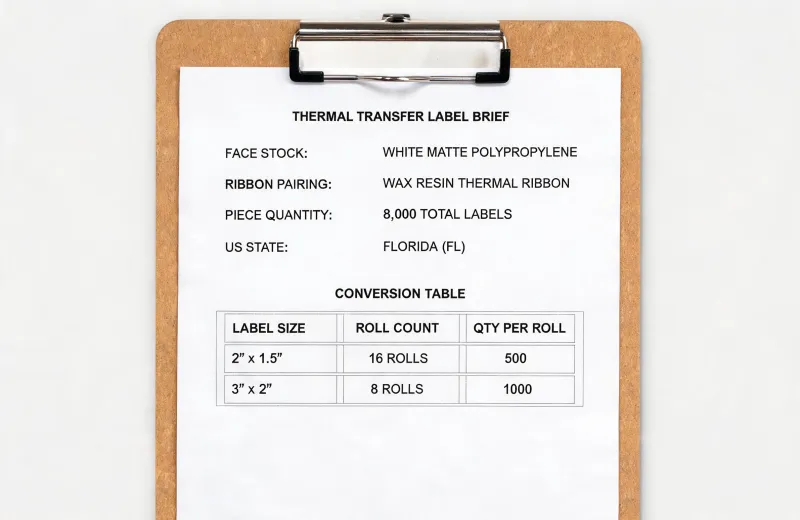
Use this page to close the specification gaps that still block a comparable custom thermal transfer labels quote. The layout shows an incomplete brief next to a complete one. It is not an energy calculator and it is not a sustainability scorecard.
Incomplete: format named, units mixed, destination missing.Complete: construction, quantity unit and ship-to on one line.
Specification completeness, not a savings meter
Tick the fields you can already write. The count is a reminder. It does not calculate price, carbon or a discount percentage. Thermal Transfer Labels Sourcing has no same-spec quote evidence that would support a published saving.
Open choices that still block a comparable quote
Unnamed face stock: paper, PP film and polyester do not share stiffness or chemical resistance.
Mixed quantity units: 20,000 labels is not the same brief as 20,000 rolls.
Print process undecided: digital print and flexographic printing change plate cost and color control.
Missing destination: freight and shipper pack-out cannot be lined up.
Construction choices that change the quote object
Dimension
Paper thermal transfer
PP film or polyester
Typical thickness
60-80 μm paper face
50-70 μm film; confirm mil vs μm
Ribbon pairing
Often wax or wax-resin
Often wax-resin or resin; name the pairing
Wet or wipe-down exposure
Often lifts or smudges
Needs a named film and adhesive
Print path
Digital or flexo for short SKUs
Flexo or gravure for long stable runs
Documents
Face-stock sheet; food-contact if required
Film + adhesive + ribbon + migration testing if required
key_specs used on this page: film thickness in mil or μm, print process and color count, and order quantity in pieces or rolls. Box ECT applies only when a corrugated shipper is part of the same line.
Procurement situations, not client case studies
Each card is a checking example. It is not a named customer, not a completed order and not a saving claim.
Paper offered against a wet brief
A factory offers paper wrap against a custom thermal transfer labels brief written for condensation or wipe-down because the artwork looks similar. The buyer should ask whether the ribbon pairing still matches. Accepting the swap without a face-stock check can fail on the printer even when die-cut size is identical.
Rewind added after plates exist
Some plants quote a sheet or fan-fold first. If a rewind specification is added after plates exist, the RFQ needs a new core, wind direction and outer-diameter note. Rewind is a construction change, not a free packing choice.
Food-contact file gap
A quote cites a previous lot's migration testing letter. The check is whether the letter names the same face stock, adhesive, ink and ribbon. If the adhesive or ribbon changes, the letter does not travel.
Limits that stay visible
This worksheet does not book US printing or set a printer-head trial date.
Post-consumer recycled content, if requested, needs a fiber or film statement for the production lot.
Direct thermal media is a different construction from thermal transfer; those fills need a named ribbon or they are a different SKU.
No discount percentage is published; price_comparisons is empty on the 2026-09-20 input set.
Digital print versus flexo or gravure
When two plants quote custom thermal transfer labels, ask which print path they priced for the pre-print. Digital print can drop plate rows on a 2,000-piece trial SKU. Flexographic printing or gravure printing can keep unit cost and spot color tighter once a 20,000-label artwork is locked. Name the run length before you treat either process as the default. A 6-color flexo label is a common pre-print brief; it is still not interchangeable with a one-color digital job on paper.
When an alternative construction is offered, verify face stock, adhesive, ribbon pairing, rewind and print process against the original line before you accept it. Continue on inquiry options or send the completed brief below.
Request a specification review
Include construction, quantity unit and destination. Optional budget and supplier preference can be added.